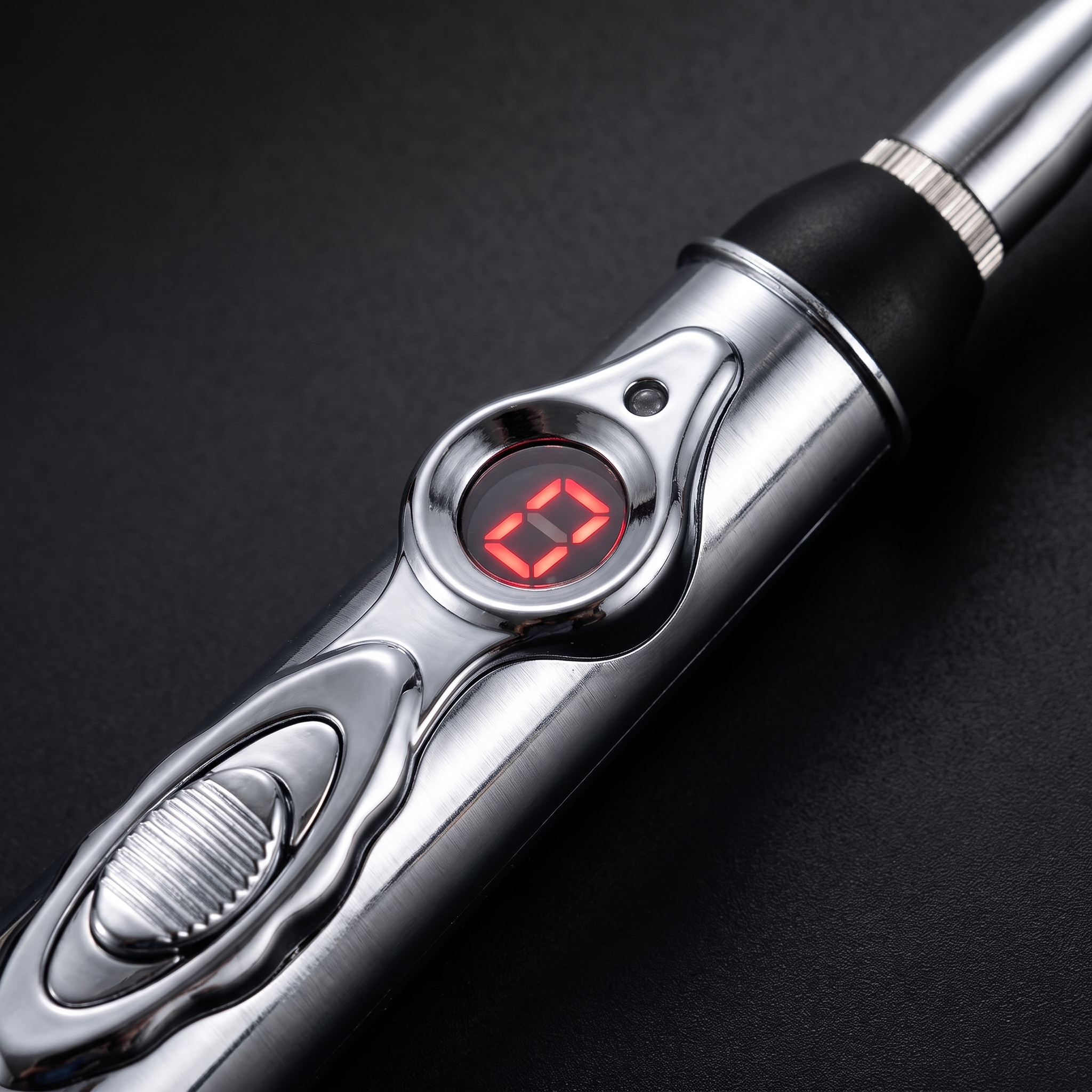
Auto point-sensing
The tip responds as it passes over an active point, so you do not need to have memorised a meridian chart first.
Secure checkout · Shopify PaymentsCard details never touch our serversTracked door-to-door
An acupressure pen you can actually check the specs on. Most listings in this category tell you what the device will do for your body. This one tells you what it is: a 158 g pen in an ABS and aluminium-alloy body, nine intensity levels on a lit display, five screw-on heads, and a single AA cell. Press the tip to a point, pick a level, and that is the whole machine.
This is a consumer wellness and massage tool that applies pressure through a metal tip along with a low-level electrical pulse, in the same broad family as the TENS units sold in any pharmacy. It is not a medical device. It is not cleared by the FDA or Health Canada, and nothing here is a health claim or a treatment for any condition. If a listing for one of these tells you it cures something, that is the moment to close the tab.
Do not use it if you have a pacemaker or any implanted electronic device, or if you are pregnant. Avoid broken skin, the front and sides of the neck, and the area near the eyes. If you have a heart condition, epilepsy or reduced sensation, ask a doctor first.
Do I need to know the pressure points first?
No. The auto-sensing tip responds as it passes over an active point, which is what most people use to find where to work.
How long should a session be?
Five to fifteen minutes across a few points, once or twice a day. Longer is not better. If a spot goes numb, sore or red, stop and move on.
What is the difference between the heads?
The fine point concentrates on one spot, the ball and spoon spread the same pressure over a wider area, and the ridged head suits a broad muscle like a calf or a forearm.
Is a battery included?
No. It takes one standard AA cell, which keeps the pen cheap to run and legal to fly with.
Nine levels. One tip. No needles
Nobody had to teach you to squeeze the back of your own neck at the end of a long day. You do it without thinking, and you go straight to the same handful of spots every time. Those spots are not a coincidence, they are the points classical Chinese medicine mapped a very long time ago, and the ones every acupressure chart still draws from today.

The points were written down
The classical Chinese medical texts set out a map of points along channels they called meridians. Whatever you make of the theory, the map itself has been in continuous use ever since, and it is still what every acupressure chart in print today is drawn from.
SourcesAcupressure (Wikipedia)Transcutaneous electrical nerve stimulation (Wikipedia)Acupuncture: what the evidence says (NCCIH)Meridian (Chinese medicine)
When people reach for it
Not a treatment plan. A small, repeatable ritual, the same one you already improvise with your thumbs, done with something that does not get tired halfway through.
Shoulders somewhere up around your ears, neck stiff on one side. Level 3 or 4 along the top of the trapezius while the kettle boils, and you get your shoulders back.
Calves, forearms, the outside of the knee. The ridged head over a broad muscle is the part most people end up using every single day.
It runs on one AA cell and weighs 158 grams, so it goes in hand luggage without a charger, a cable or an argument at security.
Low level, dim room, a few minutes on the hands and forearms. Plenty of people use it the way others use a foam roller or a hot shower, as the signal that the day is over.
What the device is actually made of and what it actually does, described the way a spec sheet should be.
The tip responds as it passes over an active point, so you do not need to have memorised a meridian chart first.
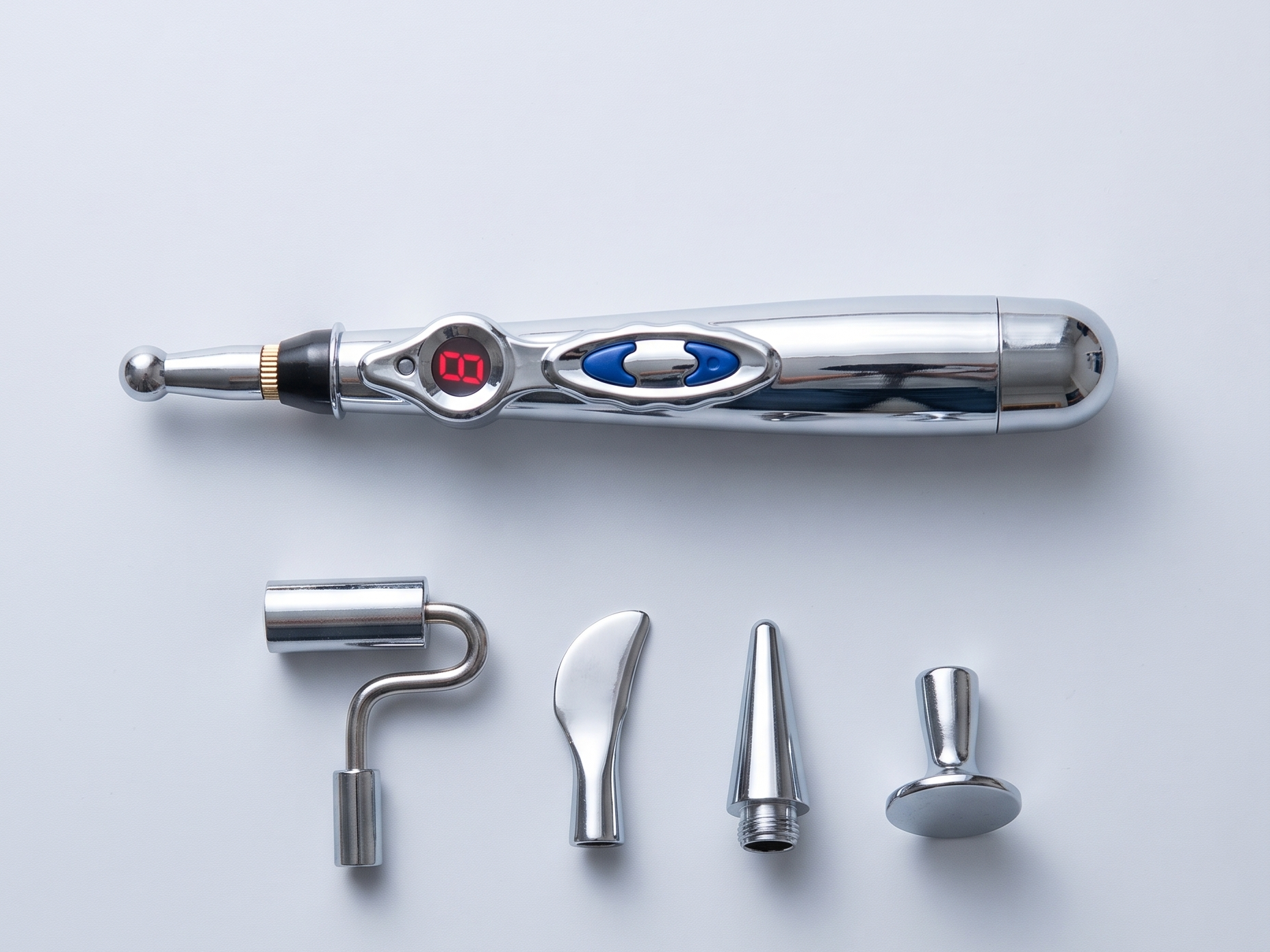
Rounded ball, ridged, fine point and flat spoon, plus the fitted tip. One pen covers a knuckle or a whole shoulder.

Tips change over without tools, so one pen covers the neck, the forearms and the lower back.
Auto-sensing acupressure pen
Electronic stimulation of meridian points through a metal tip. A wellness tool, not a medical device, and not cleared as one.
Five heads, oil-free
Ball, ridged, fine point and flat spoon tips, plus the fitted head on the pen. All five screw on and off without tools.
Oil-free
The oil-free build: nothing to reapply and nothing to wipe off afterwards.
ABS and aluminium alloy
Built for daily handling rather than occasional use.
158 g
The oil-free build, without packaging. Light enough to hold at arm's length behind your own shoulder.
OPP retail pack
The pen, its five heads and the quick-start card, shipped tracked to your door.
How it's built
There is no dock, no charging cradle and no app. The pen is a 170 mm aluminium-finish body with the control button and intensity display on the front, a threaded collar at the tip, and a single AA cell in the base. That is the whole machine.
Pick it up, screw on a head, press the button. That is the entire operating procedure.
Heads screw on and seat against a metal contact rather than pushing on. That is why the tip does not work loose halfway through a session, and why a swap takes about three seconds.
The level you set stays on the display until you change it, so the setting that suited you yesterday is the one you come back to, not a guess at the same button-press count.
No charger, no cable, no battery that dies at three years old and takes the device with it. A standard cell goes in the base, and the pen travels in hand luggage without an argument.
170 mm is deliberate: long enough to reach the points between your own shoulder blades one-handed, short enough to live in a desk drawer or a wash bag.
Put to the test
Every unit clears the same bench checks before it goes in a box: it has to power up, step cleanly through all nine levels, and hold a head without wobble. Six checks. Zero exceptions.
A cell goes in, the unit is switched on, and the intensity display is read at rest. A digit that ghosts, flickers or sticks fails here and never reaches a box.
Each unit is stepped from 1 to 9 and back. The steps have to be even and the top level has to stay inside spec, a unit that jumps a step or overshoots is rejected, not downgraded.
All five heads are fitted and removed in turn to catch a cross-threaded collar or a loose contact before it becomes a wobble in your hand three weeks in.
Every head is inspected under light: the fine point has to be smooth and burr-free, the ball and spoon heads have to be evenly polished. A sharp edge on a tip is a fail.
Pen and all five heads, counted against the packing list at the bench, because the single most common complaint about this category is a head missing from the box.
Each order is packed to arrive intact and tracked from our bench to your door. If anything arrives damaged, we replace or refund it free.
These are our own bench checks, not a regulatory clearance. The AccuPenPro pen is a consumer wellness device: it is not cleared by the FDA or Health Canada, and it is not for use with a pacemaker or during pregnancy.
Every check happens in-house, by hand, before dispatch. The full specification is laid out on this page, and the safety list is in the FAQ.
Know exactly what you're buying
This is a low-intensity stimulation device with a metal tip. Here is how it sits next to the two things you are probably already doing, so the difference is obvious before you buy, from us or anywhere else.
| This oneThe AccuPenPro pen | Stick-on TENS pads | Your own hands | |
|---|---|---|---|
| How it lands | A 2 mm tip on one point at a time | An adhesive pad across a whole area | A thumb, covering several points at once |
| Control | 9 levels on the display, repeatable tomorrow | Adjustable, usually from a separate control box | As hard as you can press before your hand gives out |
| Reaching your own back | The 170 mm body extends your reach | Somebody else has to place the pads | Not happening, and shoulders are worse |
| Running cost | One AA cell. Five reusable heads | Replacement adhesive pads, over and over | Free, and it costs you your thumbs |
| Setup | Pick it up, press the button | Peel, place, wire, dial | None |
| What it is not | Not a medical device. Not cleared by the FDA or Health Canada | Some are cleared devices, most consumer units are not | Not a substitute for seeing a doctor either |
If a listing for one of these tells you it cures anything, that is the moment to close the tab. It is a comfort tool. That is a good enough reason to own one.
Covered, or we make it right
Every order ships tracked and free, worldwide. If your pen arrives damaged, is missing a head, or is not what you ordered, send a photo within 30 days and we replace it or refund it, free, with no forms to fight through and nothing to post back.
Dispatched in 1–3 business days · 5–11 days to arrive
Send a photo within 30 days of delivery and we'll ship a free replacement or refund, and that covers damage, missing items, and mis-ships, not general change-of-mind returns.
A real person, not a bot, replies within 12 hours, 7 days a week.
Pen, all four heads, case and quick-start card, counted at the bench before it ships.
Dispatched in 1–3 business days · tracked to your door · a human answers within 12 hours
Verified customer reviews
Every review below is from a confirmed order. Reviews with a photo show the piece as it really arrived.
Showing 1–6 of 1,024 reviews
The display lit up red as soon as I put a battery in. Heads come off clean for swapping between the ball and the hook tip.
Arrived in five days, all four heads in the case. Works exactly as described.
Solid little thing. Heavier than I expected in a good way, and the button is easy to find without looking.
Good device. Wish the display had a backlight for using it in the dark.
The display is the part I did not expect to care about. Being able to go straight back to level 4 is genuinely useful.
Bought it for my desk at work. Ten minutes on my shoulders at the end of the day and I stop hunching.
If yours isn't here, email us. A person answers, usually within a few hours.
Two things at once, and neither involves a needle. Physically, the metal tip lets you press a specific point with steady, repeatable pressure, the same points you would press with a thumb. Electrically, it delivers a low-intensity pulse through that tip across nine levels, in the same broad family as a pharmacy TENS unit. That is the whole mechanism. It does not break the skin, and it is not acupuncture in the clinical sense of the word.
It is what a lot of people search for under that name, but the accurate word is acupressure pen. Acupuncture is a needle-based clinical practice; this device never breaks the skin. It is a handheld tool that combines physical pressure with a low-intensity electrical pulse on the same points, which is why it turns up in "acupuncture pen" and "electronic acupuncture pen" searches even though acupressure is the correct term for what it does.
It should not. Level 1 is a faint tingle most people describe as a tickle; the higher levels feel like a firm, rhythmic tap. Everyone's comfortable range is different, so start at 1 and work up. If it stings or feels sharp rather than tapping, lower the level or move the tip: dry skin and a bony spot both make the sensation harsher than it needs to be.
It is a low-intensity consumer device, not a medical one, and it has not been cleared by the FDA or Health Canada. Do not use it if you have a pacemaker, an implanted defibrillator or any other implanted electronic device, and do not use it if you are pregnant, or over broken skin, an open wound, a rash, the front of the neck, or the eyes. If you have epilepsy, a heart condition, a metal implant near the area, or any ongoing medical condition, ask your doctor before using it at all. None of this is boilerplate buried at the bottom of a page: it is the actual answer to the question.
Start where you already rub yourself: the base of the neck, the top of the shoulders, the forearms, the lower back, the outside of the knee. There is a fuller point guide on our blog. A sensible session is 5 to 15 minutes across a few points, once or twice a day. Longer is not better. If a spot goes numb, sore or red, stop and move on.
The pen with all five heads already in the pack (rounded ball, ridged, fine point and flat spoon). It runs on a single AA battery rather than a charger, which is also why it is fine to pack in hand luggage.
Reach and precision. A 2 mm tip lands on one point at a time, shown on a display across 9 levels, where a thumb covers several points at once and tires out, and a stick-on pad covers a whole area on a guess. The 170 mm body also reaches the middle of your own back and shoulders, which your own hands mostly cannot. There is nothing to peel, place or wire, and no adhesive pads to keep buying, just one AA battery and four reusable heads.
Shipping is free worldwide, with no minimum order. Orders are processed within 1–3 business days, then tracked delivery typically takes 5–11 business days depending on where you are. See the full country-by-country breakdown on our About page. Your tracking number arrives by email the moment the label is scanned.
We do not offer change-of-mind returns on a personal-care device, so read the safety answer above before you order. If your pen arrives damaged, is missing a head, or is not what you ordered, send us a photo within 30 days of delivery and we will ship a free replacement or refund, with nothing to send back.